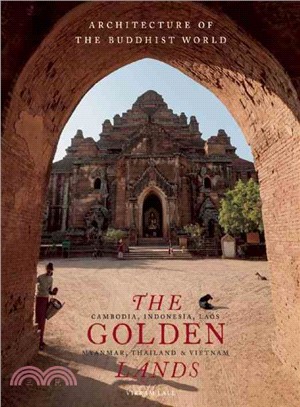
 資料來源:
三民書局
資料來源:
三民書局
The golden lands : Cambodia, Indonesia, Laos, Myanmar, Thailand & Vietnam / Vikram Lall ; editorial direction Joan Foo Mahony.
- 作者: Lall, Vikram author.
- 其他題名:
- Cambodia, Indonesia, Laos, Myanmar, Thailand & Vietnam
- Architecture of the Buddhist world
- 出版: New York, NY :Kuala Lumpur, Malaysia : Abbeville Press Publishers ;JF Publishing c2014.
- 叢書名: Architecture of the Buddhist world
- 主題: Architecture , Buddhist architecture , Architecture--Southeast Asia--Designs and plans. , Buddhist architecture--Southeast Asia.
- ISBN: 0789211947 、 9780789211941 (hbk.): NT$2528 、 9789670138039 、 9670138035
- 書目註:Includes bibliographical references (page 277) and index.
-
讀者標籤:
- 系統號: 000822473 | 機讀編目格式
館藏資訊

本館視聽資料與可外借圖書提供預約服務,每張借閱證總共可預約10冊(件)。
密集書庫中不可外借圖書提供調閱服務,每張借閱證總共可調閱10冊(件)。
如預約/調閱圖書或視聽資料因破損、遺失等因素無法借閱時,本館將以電子郵件或電話簡訊通知讀者取消該筆預約/調閱申請。
A groundbreaking survey of the Buddhist architecture of Southeast Asia, abundantly illustrated with new color photography and 3-D renderingsOver the course of its 2,500-year history, Buddhism has foun
摘要註
Over the course of its 2,500-year history, Buddhism has found expression in countless architectural forms, from the great monastic complexes of ancient India to the fortified dzongs of Bhutan, the rock-carved temple grottoes of China, the wooden shrines of Japan, and the colorful wats of Cambodia, Laos, and Thailand. Architecture of the Buddhist World, a projected six-volume series by the noted architect and scholar Vikram Lall, represents a new multidisciplinary approach to this fascinating subject, showing how Buddhist thought and ritual have interacted with local traditions across the Asian continent to produce masterpieces of religious architecture. The first volume in the series, The Golden Lands, is devoted to Southeast Asia, home to many of the most spectacular Buddhist monuments. Following a general introduction to the early history of Buddhism and its most characteristic architectural forms (the stupa, the temple, and the monastery), Lall examines the Buddhist architecture of Myanmar, Vietnam, Indonesia, Cambodia, Thailand, and Laos in turn. For each country, he provides both a historical overview and case studies of noteworthy structures. Lall's concise and accessible text is illustrated throughout with new color photography, as well as 3-D architectural renderings that make even the most complex structures easily comprehensible. The monuments that Lall considers in The Golden Lands range from the modest Bupaya stupa, constructed in Bagan, Myanmar, in the third century AD, to the vast complex of Borobudur in Central Java, the world's largest Buddhist monument; his achievement is to place them all within a single panorama of history, religion, and artistic innovation.
內容註
A chronology of selected Buddhist monuments -- The theoretical framework -- Myanmar : I. Architectural history : Emergence of early settlements ; The advent of Buddhism: myth and reality ; Early material evidence ; The cultural influence of India ; The Pyus: the culture, cities and buildings Peikthano; Sri Ksetra ; The Mons of lower Myanmar ; The cultural region of the Rakhines ; The Burmans and the kingdom of Pagan -- II. Architectural characteristics : Buddhist architecture in Myanmar, mainly of the Pagan period : Monument categories ; Stupas ; Temples: two distinct plan types ; Temples: interiority ; 'Gu': the notion of the cave ; Ordination halls ; Monasteries ; The phenomenal use of brick ; Pentagonal monuments ; The Sri Lankan influence ; Mahabodhi: copy of an Indian paradigmatic model ; Resurgence of wood and wooden monasteries ; Hsinbyume: a representation of Mount Meru ; Kuthodaw: scripture in stone -- III. Selected examples : Manuha ; Pitaka Taik ; Ananda ; Shwezigon -- Vietnam : I. Architectural history : Buddhism during the millennium before the 10th century and independence ; The 10th century: Buddhism under early independent kingdoms ; From the 11th to the 13th centuries: the Ly dynasty and the golden age of Buddhism ; The 13th to the 15fh centuries CE: the Tran dynasty ; THe 15th to the 16th centuries: The revival of Confucianism ; The 17th and 18th centuries: the restored Ly dynasty ; th 19th and 20th centuries -- II. Architectural characteristics : Site selection ; Wooden buildings ; THe temple and its different halls ; Planning typologies of the temples ; Arrangement of altars and statues -- III. Selected examples : Dau Pagoda ; Mot Cot ; But Thap ; Thay Temple -- Indonesia : I. Architectural history : Co-existence of Hinduism and Buddhism ; The Srivijaya kingdom and the emergence of Buddhism ; Srivijaya's architectural heritage ; The golden age of Buddhism in Java -- II. Architectural characteristics : Candi: a single shrine structure ; The square plan ; The mandalic planning and mountain temples -- III. Selected examples : Candi Kalasan ; Candi Mendut ; Borobudur -- Cambodia : I. Architectural history : Leading up to Angkor ; King Jayavarman VII ; The decline of the Khmers -- II. Architectural characteristics : The temple-mountains ; Prasats and Gopuras ; Transformation of Prasat into face-tower ; The Quincunx ; Water in Cambodian religious architecture ; Other buildings in a monastic precinct ; Building materials -- III. Selected examples : Ta Prohm ; Preah Khan ; Neak Pean -- Thailand : I. Architectural history : Mon and Dvaravati ; Sinhalese and Srivijaya influences ; The Khmer legacy ; The Tai Ascendant: Sukhothai ; Ayutthaya: revival of the Khmer legacy -- II. Architectural characteristics : Symbolism: Hindu, Buddhist cosmology ; The central shrine: the Prang and the Chedi ; The assembly halls: Ubosot or Bot and Wihan -- III. Selected examples : Wat Mahathat, Sukhothai ; Wat Arun ; Wat Suthat -- Laos : I. Architectural history : The articulation of the Buddhist notions of space and form ; Efflorescence of Buddhism and architecture ; The revival of a Buddhist identity -- II. Architectural characteristics : The monastic precinct: the Vat ; The main building or central shrine hall: the Sim ; Other buildings in a vat ; Stylistic classifications of temples in Luang Prabang -- III. Selected examples : Tat Luang ; Vat Xieng Thong ; Vat Mai -- Glossary.